What is Audio Vivid? A New Destination for Immersive Audio
Over the past several years, immersive audio has evolved from a niche production consideration into an established part of modern music production. Dolby Atmos has led that transformation, bringing object-based mixing into recording studios of every size and making immersive music available to millions of listeners through streaming services, home theaters, and headphones.
As immersive production has matured, so have the tools engineers rely on to create it. Symphony I/O Mk II introduced Monitor Workflows, making it easy to switch between stereo, surround, and immersive monitoring configurations with independent speaker level trims for each workflow. Building on that foundation, Symphony Studio further simplifies immersive monitoring with integrated bass management, room EQ, speaker delay compensation, and seamless switching between stereo, surround, and immersive monitoring configurations.
Today, immersive audio continues to grow, and with it, new delivery ecosystems are beginning to emerge. One of the newest is Audio Vivid.
The good news is that Symphony I/O Mk II and Symphony Studio already support Audio Vivid production workflows. Because Audio Vivid shares the same object-based production concepts familiar to Dolby Atmos users, the monitoring environment you’ve already built—from stereo to immersive speaker layouts—remains directly applicable. Whether you’re creating immersive content for Atmos, Audio Vivid, or future object-based formats, Symphony provides the monitoring flexibility and precision required throughout the production process.
Familiar Concepts, New Destination
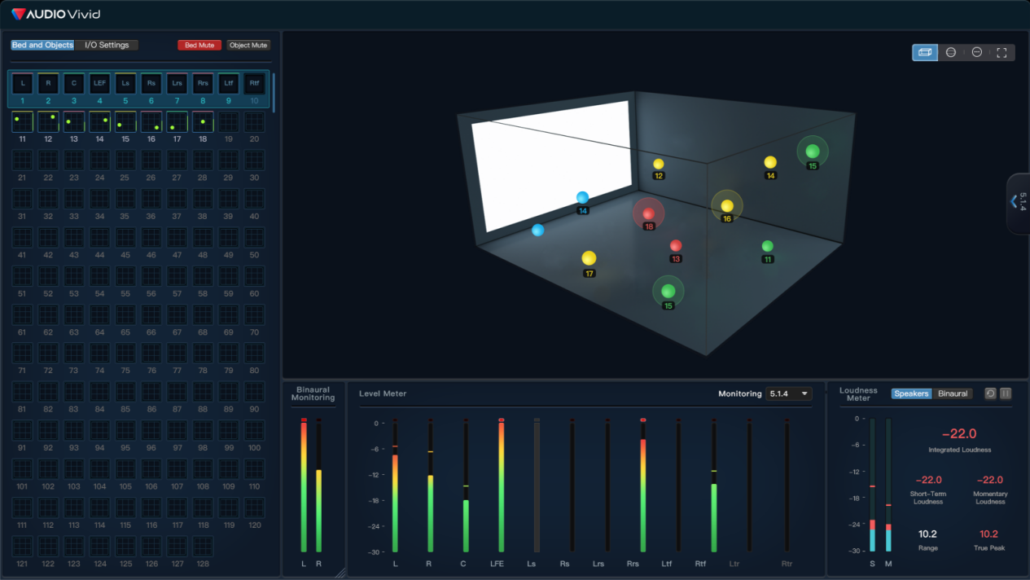
The easiest way to understand Audio Vivid is not as a replacement for Dolby Atmos, but as another object-based immersive ecosystem. Like Atmos, Audio Vivid combines:
- Audio beds
- Independently positioned objects
- Spatial metadata
- A renderer that adapts playback to the listener’s system
Whether the final mix is experienced over headphones, a soundbar, an automotive system, or a full 7.1.4 or 9.1.6 loudspeaker array, the renderer is responsible for recreating the immersive sound field as accurately as possible. For engineers already working in Atmos, these concepts should feel immediately familiar.
Already Mixing in Atmos? You’re Most of the Way There
One of the biggest misconceptions surrounding Audio Vivid is that it requires learning an entirely new production workflow.
It doesn’t.
If you’re authoring immersive mixes in Pro Tools today, your session structure, object placement, automation, monitoring, and creative decisions remain largely the same. In many cases, preparing a project for Audio Vivid is simply a matter of selecting a different renderer, validating the resulting mix, and exporting in the appropriate format.
The skills you’ve developed building immersive mixes don’t suddenly become obsolete because another delivery format exists.
If anything, Audio Vivid demonstrates that object-based production has matured into a workflow that can support multiple delivery ecosystems. Rather than replacing Dolby Atmos, it expands the ways immersive content can be delivered to listeners.
Why Audio Vivid Exists?
So if the workflow is so similar, why introduce another immersive format?
The answer has less to do with how immersive audio is created and more to do with how it’s delivered.
Streaming services continue to bring immersive audio to larger audiences across an increasingly diverse range of playback devices. That presents new challenges: reducing bandwidth, minimizing storage requirements, and delivering immersive experiences efficiently across mobile devices, televisions, automobiles, and home entertainment systems.
Audio Vivid was designed with those challenges in mind.
One of its distinguishing features is an AI-assisted coding architecture that helps compress immersive audio more efficiently for distribution while preserving the spatial information that makes immersive mixes convincing.
Importantly, this AI isn’t involved in creating or mixing your music. It operates during the encoding process, after the creative work is complete.
From the engineer’s perspective, the mix remains the priority. The codec simply becomes another method of delivering that mix to listeners.
What This Means for Symphony Users
Both Symphony I/O Mk II and Symphony Studio are ready for Audio Vivid production today. Because Audio Vivid builds on the same object-based production concepts as Dolby Atmos, the immersive monitoring environment you’ve already created continues to serve as the foundation for this emerging workflow.
Whether your final deliverable is Dolby Atmos today, Audio Vivid tomorrow, or another object-based format in the future, the engineering challenges remain remarkably consistent.
You still need to:
- Monitor accurately across multiple speaker layouts
- Trust your loudspeaker calibration
- Verify translation between stereo and immersive playback
- Move quickly between monitoring formats without interrupting your workflow
Symphony I/O Mk II makes it easy to move between stereo, surround, and immersive monitoring configurations using Monitor Workflows.
Symphony Studio builds on those capabilities with integrated bass management, room EQ, speaker delay compensation, making it a complete immersive monitoring solution directly within Apogee Control 2.
These capabilities aren’t just specific to Dolby Atmos.
They’re adaptive and relevant to all forms of professional immersive production.
As additional immersive delivery formats continue to emerge, the value of a flexible, well-calibrated monitoring environment only continues to grow.
Looking Ahead
Audio Vivid isn’t a signal that immersive audio is changing direction.
It’s a sign that immersive audio continues to gain momentum.
As more streaming platforms, broadcasters, and hardware manufacturers adopt object-based audio, engineers will increasingly find themselves delivering immersive content to multiple ecosystems built around many of the same production principles.
For those already working in immersive audio, that’s an encouraging development. It means the investment you’ve made in learning object-based mixing continues to gain value.
With support for Audio Vivid production workflows alongside the immersive monitoring capabilities already trusted by Dolby Atmos creators, Symphony I/O Mk II and Symphony Studio give engineers the confidence to take on whatever immersive projects come next.
Learn More
If you’re interested in exploring Audio Vivid production in greater detail, these resources provide an excellent starting point.
Avid – Audio Vivid Resource Center
Learn how Audio Vivid integrates into Pro Tools workflows, including renderer setup, session preparation, and delivery.
https://www.avid.com/resource-center/audio-vivid
Asia-Pacific Broadcasting Union – Audio Vivid: The Next Generation of Audio Coding Standard
A technical overview covering the architecture, coding technologies, and intended applications behind Audio Vivid.
UHD World Association – Audio Vivid Technical White Paper
Published by the UHD World Association (UWA), the organization behind the Audio Vivid standard, this white paper provides the most comprehensive technical overview of the format. It explores the design goals behind Audio Vivid, its object-based rendering architecture, AI-assisted coding technology, supported playback environments, and the broader ecosystem driving its adoption.
https://uhd-world-association.com/wp-content/uploads/2024/10/30-W00001-202208-Audio-Vivid-Technical-White-Paper-.pdf